


Syllabus: GS3/ Economy
Context
- Welfare freebies are being increasingly offered by states, and while overall state finances in India are broadly stable, fiscal stress is rising in highly indebted states.
Fiscal Position of States
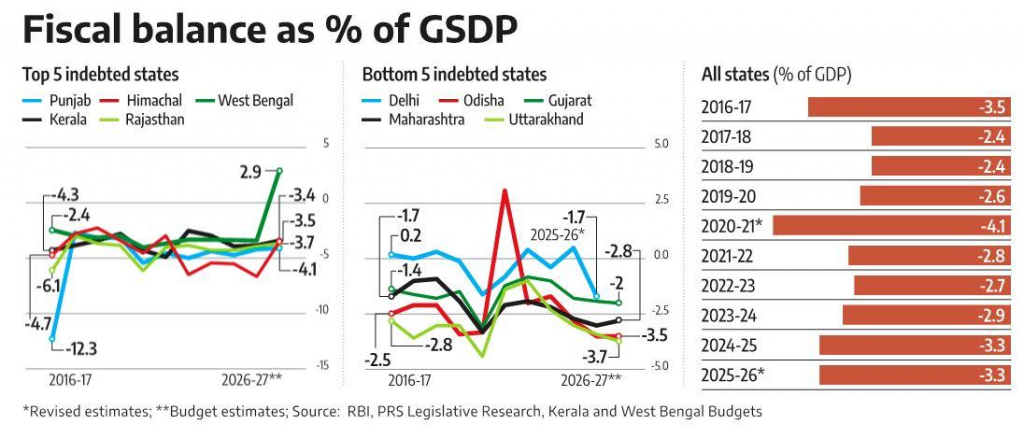
- The combined fiscal deficit of states was below 3 percent of gross domestic product during FY2017-FY2024, except during the COVID-19 pandemic when the deficit rose to 4.1 percent of gross domestic product in FY2021.
- The fiscal deficit of states increased to 3.3% of GDP in FY2025 and is projected to stay at the same level in FY2026.
- To ensure fiscal prudence, the 16th Finance Commission has recommended that states must retain the fiscal deficit limit of 3 percent of Gross State Domestic Product (GSDP).
What is the fiscal deficit?
- Fiscal Deficit is defined as excess of total budget expenditure (revenue and capital) over total budget receipts (revenue and capital) excluding borrowings during a fiscal year.
- Fiscal Deficit = Total Expenditure – (Revenue Receipts + Non-Debt Creating Capital Receipts).
Variation in Fiscal Management Among States
- States vary widely in their capacity to control welfare spending without endangering fiscal stability.
- Expenditure on unconditional cash transfer schemes, particularly those targeted towards women, has increased significantly in recent years.
- Spending on such schemes has increased from 0.01% of GDP in FY2021 to around 0.57% of GDP in FY2026 (Budget Estimates).
- Among states, Jharkhand spends the highest share of its GSDP (Gross State Domestic Product) on unconditional cash transfers at around 2.1%, followed by West Bengal, Odisha, Madhya Pradesh, Chhattisgarh, Kerala and Maharashtra.
- Odisha has been able to fund its welfare schemes largely through its own revenues and has been maintaining a revenue surplus since FY2016.
What are Freebies?
- Freebies are non-merit, consumption-based benefits that do not create long-term public assets and are usually meant for immediate relief or electoral appeal.
- Often the practice is used by political parties offering free goods, services, or subsidies to the public, particularly during election campaigns, in an attempt to garner votes.
- Section 123 of the RP Act deals with ‘corrupt practices’, it says that it is deemed a corrupt practice if any gift, offer or promise of gratification is made to voters directly or indirectly by a candidate or his agent or any other person acting on their consent.
- S. Subramaniam Balaji vs. State of Tamil Nadu (2013): The Supreme Court upheld the right of political parties to offer freebies but emphasized that the distribution of freebies should be done responsibly.
- It stated that only an individual candidate, not his party, can commit a ‘corrupt practice’ under the RP Act by promising free gifts.
Concerns Related to Freebie-Based Expenditure
- Growing debt burden: States with weak revenue bases and limited fiscal capacity could see their debt burden increase as subsidy and cash transfer expenditure rises.
- Crowding Out of Productive Spending: Excess allocation towards revenue expenditure may shrink the fiscal space for investments in infrastructure, health, education and other productive sectors.
- Less fiscal flexibility: Long-term commitments under welfare schemes might reduce the capacity of states to respond effectively to financial crises, natural disasters or other emergencies.
- Fiscal risks not revealed: Absence of transparency on off-budget borrowing and contingent liabilities can generate hidden fiscal risks and threaten the sustainability of government finances.
Way Ahead
- States need to strengthen their Fiscal Responsibility and Budget Management (FRBM) frameworks to ensure fiscal discipline.
- The FRBM framework implemented by way of the FRBM Act, 2003 is a set of rules and principles to ensure fiscal discipline, control government borrowing, reduce fiscal deficits and promote sustainable public finances.
- States need to increase their own revenue generation and cut down excessive borrowing.
- More attention should be paid to productive investment in the form of capital expenditure and to the promotion of long-term economic growth.
- Public finances should be sustainable, and this requires that off-budget liabilities be reported transparently and fiscal assessments be made regularly.
Source: BS
